
If you’re looking for a way to turn back the clock without going under the knife, Ultherapy has likely topped your search results.
It’s often dubbed the “non-surgical facelift,” but unlike many beauty treatments that focus on the skin’s surface, Ultherapy goes much deeper.
Here is a breakdown of how this FDA-cleared technology works to lift and tighten the skin from the inside out.
Here in this article:
How Ultherapy Uses Ultrasound?
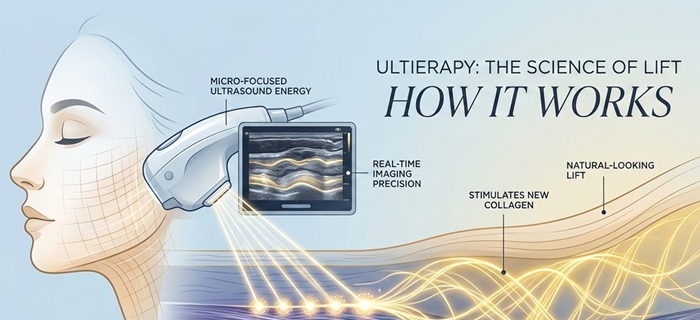
Most skin tightening treatments use lasers or radiofrequency, which penetrate the skin from the outside in. Ultherapy is unique because it uses Micro-focused Ultrasound (MFU).
Think of it like a magnifying glass focusing sunlight onto a specific point.
The ultrasound energy passes through the surface of your skin without harming it, delivering targeted heat to the foundational layers—specifically the SMAS (Superficial Muscular Aponeurotic System).
This is the same deep tissue layer that surgeons manipulate during a traditional facelift.
By heating this tissue to an optimal temperature (between 60°C and 70°C), Ultherapy triggers a natural biological response known as neocollagenesis.
Essentially, the heat creates “micro-injuries” that jumpstart your body’s repair mechanism, leading to the production of fresh, new collagen.
Real-Time Imaging: Precision Meets Personalization
One of the biggest advantages of Ultherapy is its See-Plan-Treat technology.
During the procedure, the practitioner uses ultrasound imaging—similar to the technology used to view a baby in the womb—to see the different layers of your tissue in real-time.
The Singapore Ultherapy Facelifting Treatment is a game-changer for two reasons:
- Safety: It ensures the energy is delivered to the most beneficial depths.
- Customization: Everyone’s anatomy is different. Real-time imaging allows the provider to avoid bone or blood vessels while targeting the areas where you have the most significant skin laxity.
What to Expect with Ultherapy: Results and Recovery
Because Ultherapy relies on your body’s own collagen-building process, the results aren’t instant.
While you might notice a slight “boost” immediately after the session due to temporary inflammation, the real magic happens over time.
- 2–3 Months: You’ll begin to see a noticeable lift and improved contouring around the jawline, neck, and brow.
- 6 Months: This is usually when peak results are visible as the new collagen matrix fully matures.
- Downtime: There is virtually none. You might experience some slight redness or tingling, but most people head straight back to work or their daily routine.
Pro Tip: Since Ultherapy works with your body’s natural resources, maintaining a healthy skincare routine and wearing SPF will help protect your new collagen and extend the life of your results.
Ultimately, Ultherapy stands out as a premier choice for those seeking significant structural lifting without the risks or recovery time of surgery.
By leveraging the body’s own regenerative power, it offers a sophisticated way to address sagging skin at its source.
While it requires a bit of patience as your collagen levels gradually replenish, the result is a refreshed, more youthful appearance that looks entirely natural.
If you are looking for a scientifically-backed treatment that bridges the gap between topical creams and invasive facelifts, Ultherapy provides a precise, personalized solution for long-term skin health.


